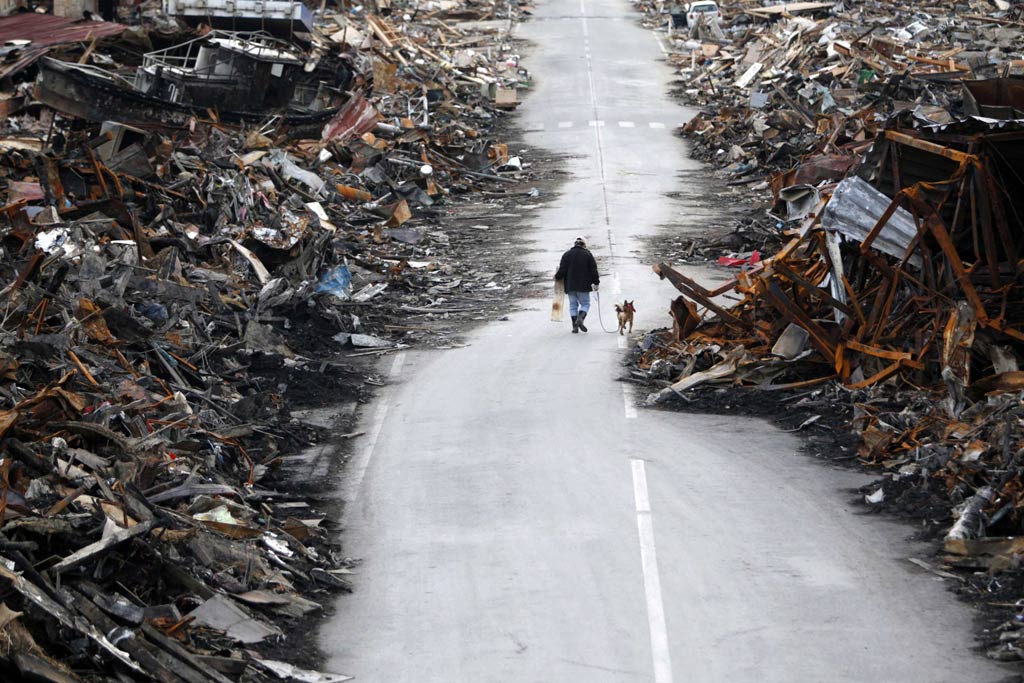
The Tohoku earthquake and tsunami, as well as the subsequent meltdown debacle are events that I am lucky enough to have experienced first-hand, yet walk away from. I am obviously grateful for this, yet at the same time filled with sadness over those less fortunate than I, who were literally in the wrong places at the wrong time. I will never forget my experience on that day in March 2011.
I still remember it like it was yesterday. I had just left school after a long day of that particular brand of play-teaching one employs on 小学校 days, but by all accounts it was still a (brisk) beautiful day. After a quick zip down my favorite mountain back roads in my Subie, I stopped in at my office to check in and round off the day before following through on plans to hop on my motorcycle for a quick spin. Right as I began a fluffy conversation with the only other two folks in my department, things began to shake. This wasn’t particularly nerve-wracking; I’d experienced quakes before but always held them in this contemptuous light, openly mocking them on a regular basis. As the conversation shakily continued, the large overhanging 教育委員会 sign swung furiously, with no sign of letting up.
Normally, within a minute of starting up, things tended to settle down and people brushed themselves off, picked up the few things that may have fallen, and resumed their daily routines. On March 11, however, it was clear that this earthquake was only getting started. The old town hall building was sturdy, but soon the slight jiggle underneath my feet and the furious shaking of the signs merged together, and the entire building began lurching precariously. Two and a half minutes in and everyone knew that this was NOT a “normal” earthquake. The old ladies of the tea ceremony club and various office staff began gathering in the lobby of the building, unsure of what to do or where to go, but finding comfort amongst numerous others who felt the same sense of unsurety. When I could feel the heaviness of the floors above in my feet, I knew it was time to go outside to an open area immediately, if for nothing more than my own peace of mind.
Outside I watched the parking lot turn into Jell-O, as it wobbled like it had been plucked, along with the cars, trees, and street lamps attached to it. This point was the first time I had ever given any real consideration to the fact that I could possibly die on this escapist island paradise of mine. Noticing that no one had followed me out of the jiggling building, I resigned to see the rest of the situation through with my co-workers inside. After what seemed like an eternity, during which I was all but convinced that the old building we occupied would collapse around us, the shaking and rumbling subsided. After six minutes of uncertainty, things went back to normal. Or so it seemed. We all expressed our relief at the experience drawing to a close, and I went home for the day.
For me, the 2011 Tohoku Earthquake was a somber lesson not to trivialize or treat danger as a novelty, as well as another reminder that life is precious. Although I was shaken up, after those six minutes had passed, I was able to go home. I honestly didn’t realize that so many folks weren’t going to make it home, go to bed, and sleep off a bad day. Six minutes changed everything for them. The next morning, I woke up to the news of the tsunami and its devastation, and the developing crisis at 福島第一 , and only then did it strike me that the prior day’s rumbling was simply the tip of an iceberg that would change things for years to come.
Six minutes on March 11, 2011. How did you spend them?
-Namakemono
Category Archives: News
Anonymous Is Challenging American Political Tyranny With Its’ Million Mask March On Washington, D.C.
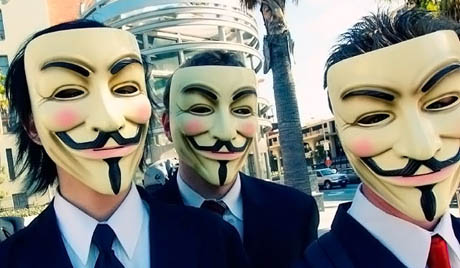
Hactivist collective Anonymous has decided enough is enough, and that it’s time for Americans (and sympathetic others around the world) to stand up and reclaim their government from the clutches of corrupt politicians who espouse tyranny. The group announced that on November 5th, it will hold a “million mask march” in which they expect hundreds of thousands of participants to descend upon over 400 locations, including Washington, D.C., in an expression of solidarity against oppression and despotism.
Participants are encouraged, though not required, to don masks featuring the likeness of Guy Fawkes, known for his involvement in the Gunpowder Plot. Originally seen as a symbol of treachery, popular culture eventually rewrote his legacy as that of a hero fighting against the unjust, and November 5th was designated Guy Fawkes Day. The 2006 film V for Vendetta gave us the popular stylization of his visage, and Anonymous eventually appropriated this mask and the date for its own purposes.
The main event is scheduled to occur at the Washington National Monument, evoking memories of well-known gatherings such as the legendary March on Washington for Jobs and Freedom, and countless other Million [insert noun here] Marches.
Exactly what Anonymous hopes to achieve through this march is unclear, beyond expressing its discontent with the state of affairs in the American government. However, the group is known for its decentralized and laissez-faire approach to organization, and the march may signal its shift towards a more clearly identified and focused agenda. It will also serve as a litmus test, gauging the eagerness of Americans to commit to another Occupy Wall Street style movement.
Ultimately though, it’s difficult to imagine the group scoring a clear and significant victory with this march. While most Americans are fed up with the political antics that have caused a never ending governmental stalemate, there is no acute impetus novel enough to rally around, as with the Great Recession and the Tea Party movement in 2009, or the global crescendo of political instability which lead to the Arab Spring and Occupy Wall Street movements. Furthermore, even with the massive support, publicizing, and dissemination of its objectives, Occupy Wall Street has all but disappeared, and it failed to accomplish its major goals. Anonymous shares many of these goals, but has none of the momentum behind it, or a real platform from which to combat the financial and political discrepancies plaguing the nation (because let’s be honest, it’s going to take a lot more than hacks and DDoS attacks to fix our problems).
Still, if Anonymous is serious about revamping its approach and transforming into a more effective political action group, it has picked a uniquely Millennial approach for doing so, creating a cultural mashup of a call to action. So as Guy Fawkes, V, or Anonymous might say, “Remember, remember, the 5th of November,” and keep fighting for your inalienable rights. The status quo is betting that you won’t.
Published on .Mic , November 1, 2013
-Namakemono
Violent Video Games Did Not Make Aaron Alexis a Cold Blooded Killer
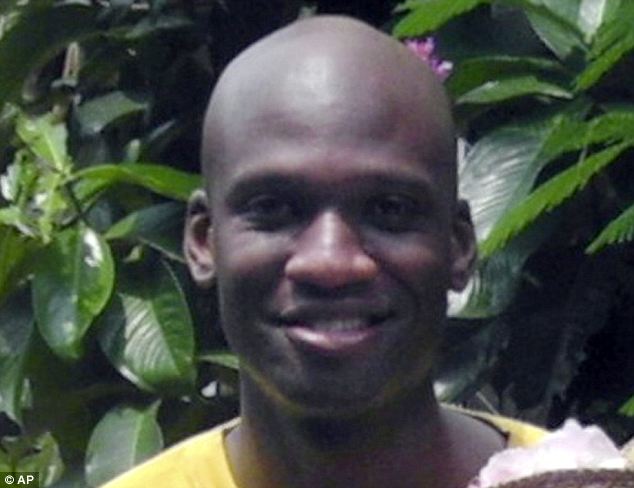
By now it’s likely that you’ve heard the unfortunate news about Monday’s mass murder at the Washington Navy Yard. You’ve probably seen images of the man responsible, Aaron Alexis, and collected bits and pieces of information as it was made available. You may know that 13 people, including the gunman died. Maybe you’ve also learned that several people were injured as well, and watched their names scroll by on your television as the political pundits of the evening emotionlessly expressed their “heartfelt” sympathy and outrage. Perhaps you’ve also been told that Alexis was an avid, almost obsessive player of violent video games, which may have caused him to commit this mass murder.
It is an undeniable fact that Alexis is a killer, guilty of murdering 12 innocent people and injuring several others who were simply in the wrong place at the wrong time, and it would be an insult to them to say anything otherwise. To suggest, however, that a video game or other form of entertainment is ultimately responsible for his heinous act is an insult to innocent Americans and an irresponsible denial of the ramifications of our overzealous gun culture.
Video games, music, films, and indeed most forms of media have been the target of censorship for probably as long as these methods of sharing stories have existed. Looking back over the lifetime of most millennials, you’ll see the introduction of restrictions upon music with explicit lyrics, content ratings for television shows and video games, and going back to the first half of the 20th century, rating systems for films as well.
Many of these were created with the goal of preventing content deemed unsatisfactory from influencing the attitudes, opinions, and behaviors of American society. For example, the parental advisory label which can be found on many albums today is a reaction to content from artists such as Prince and Ice-T, which were often derogatory and featured vivid depictions of violence and sexuality. At the time, leaders of the movement in favor of these labels, such as Tipper Gore, argued that being exposed to these vivid depictions would result in an increase of violence and a loosening of sexual morality amongst American youth.
While this could be true, the fact of the matter is that worldwide, most millenials, having grown up steeped in technology, have found ample opportunity to listen to whatever music they want, play whatever games they like, and indeed consume whatever media they choose despite the restrictions placed upon them. What is dramatically different in America, compared to other countries, is the level of real world violence that occurs around them.
Take Japan for example. In 2012, at least five of the top thirty best-selling video games were from franchises known for their violent themes and depictions of explicit behavior. Resident Evil 6 was the fifth most popular game that year. However, there are nearly 200 times more murders with firearms in America than Japan. In 2002, there were 47, compared to 9369 in America. The overall crime rate is significantly lower as well. The same goes for Great Britain. In fact, there are nearly 670 times more murders with firearms in America than Britain. If Japanese and British citizens, and indeed people from any other country are for the most part consuming the same types of media, yet live with significantly lower murder rates, then the problem isn’t the entertainment, but clearly the culture of violence, or lack thereof.
In five years of living in Japan, I noticed that more people were genuinely concerned when a local convenience store was robbed at knifepoint, than at home in the Bronx when a shooting occurred in front of the local bodega. There was a desire to ensure that everyone involved was alright, and it was entirely unthinkable that something of this nature could ever happen. This is because from a young age, Japanese people are taught to respect each other and to resolve their issues through working together. More importantly, guns are outright illegal, and the concept of achieving your goals at the expense of another person’s safety or wellbeing is not accepted.
In fact, in America, it is the ease with which we accept real life violence and the eagerness to hurt others in order to secure our own prosperity that is in large part responsible for situations like that at the Washington Navy Yard. America is an incredible country and our free spirit is a large part of what made America what it is today, but without change, it will crumble apart from the inside out. Moving forward, Americans must stop blaming films and video games for the violent incidents that time and again hit the nation at its core, and learn to embrace the best practices of our global neighbors.
Published on .Mic
-Namakemono
Related articles
- Aaron Alexis: Washington navy yard gunman ‘obsessed with violent video games’ (telegraph.co.uk)
- ‘The Video Games Did It!’ The Stupid Response to Mass Violence That Has Infinite Lives (reason.com)
- Fox News’ Hasselbeck: Navy Yard shooting shows need for video game registry, not gun control (rawstory.com)
- Don’t Blame Violent Video Games for Monday’s Mass Shooting (theatlanticwire.com)
Whether Syria Joins The Chemical Weapons Convention Or Not, Bashar al-Assad Must Go
Bashar al-Assad Must Go
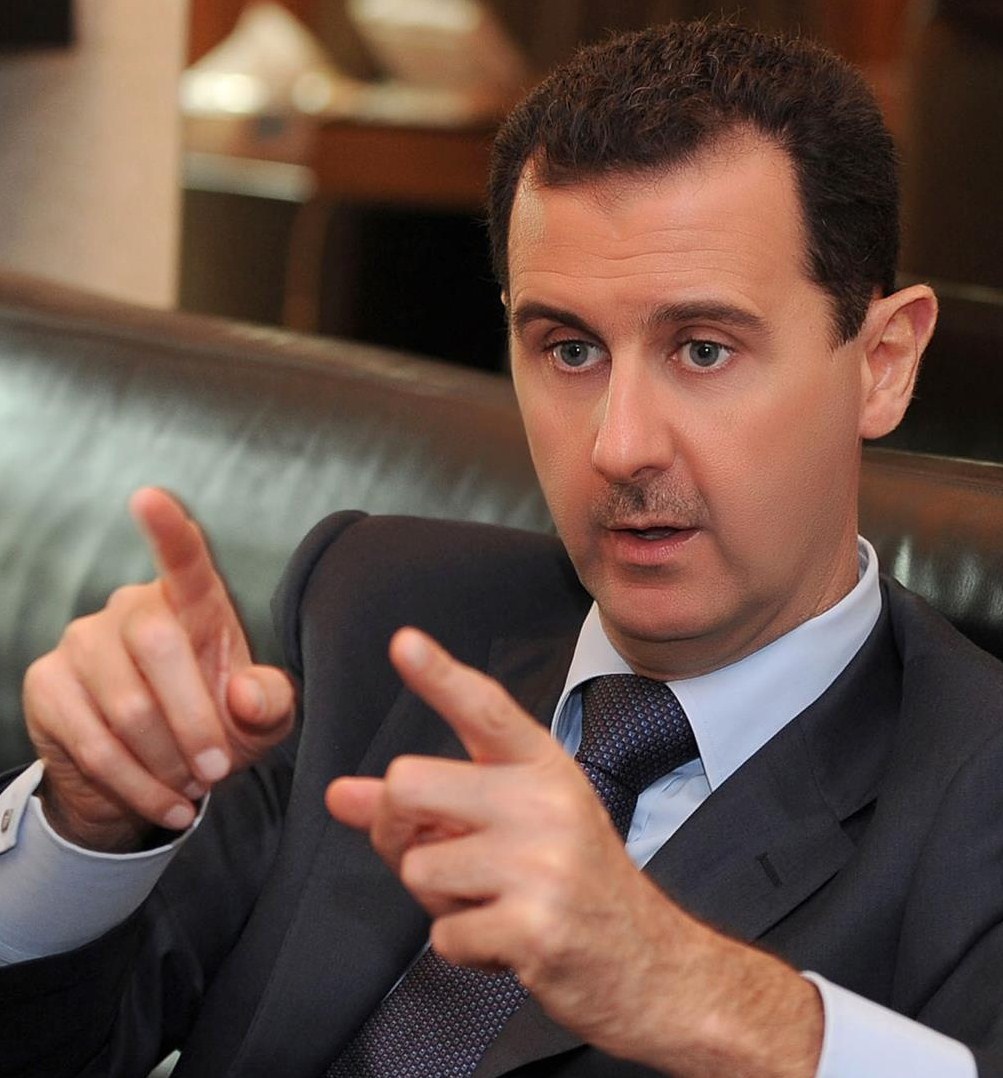
The use of chemical weapons in the ongoing conflict in Syria is in direct violation of the Chemical Weapons Convention (CWC); however, Syria is not currently party to this agreement. This presents a unique opportunity for all major parties involved to ratchet down the international brinkmanship at play. While it most likely won’t end the fighting in Syria, Bashar al-Assad following through with his tentative pledge to relinquish Syria’s chemical weapons and join the CWC signifies a major turning point in the conflict, because it gives America a clear choice on how to proceed.
The CWC is an important piece of the puzzle in establishing a meaningful dialogue between Syria and the U.S., but to be clear, at this point in the conflict anything achieved through it will simply be a half-measure, and would require the world to be ok with choosing the greater of two evils.
Open for adoption since January 13, 1993, the CWC is an arms control agreement created by the U.N. to address a lack of restriction upon the production and stockpiling of chemical weapons. While the Geneva Protocol of 1925 originally prohibited the use of chemical weapons in warfare, it left several loopholes through which countries were able to justify their possession and use of these weapons. The CWC introduced strict oversights aimed at identifying and eliminating stockpiles of chemical weapons.
Parties to the CWC must not “develop, produce, otherwise acquire, stockpile or retain chemical weapons, or transfer, directly or indirectly, chemical weapons to anyone.” They are also required to report their possession of chemical weapons as well as the facilities used to design and produce them, and destroy both the weapons and facilities or provide detailed plans for their conversion to non-prohibited purposes. The convention also includes provisions for inspections and sanctions in order to ensure compliance with the agreement.
The CWC went into enforcement in 1997 after being ratified by 65 nations, and there are currently 189 nations that have joined the agreement. In the twenty years since it was originally adopted, Syria has been one of the few members of the U.N. that has not acceded to the convention, and it has made no secret of its possession of chemical weapons and its willingness to use them should the need arise. This is why Syria’s sudden willingness to renounce its chemical weapons stockpiles is both surprising and inviting of skepticism.
Syria’s acceptance of the CWC would likely spare countless individuals from a painful death caused by chemical agents and put the country in line with the rest of the world. In and of itself, this is absolutely a good thing. The measure would serve as a symbolic gesture, and would allow Syria and other nations to stop shouting at each other and start talking about a realistic ending to the conflict in Syria. It would not, however, stop the killing of innocent people by a regime bent on retaining power by whatever means necessary, and in all likelihood, will not lead to the resolution of the conflict because the problem is Assad himself.
Assad has already proven his unwillingness to step down from office, and his eagerness to fight his opposition into submission. He has killed more than 200,000 people, and displaced over 6 million as a result of his actions. Allowing him to save face by joining the CWC only strengthens his position, and allows the rest of the world a convenient exit from an uncomfortable situation. Even without chemical weapons, the Assad regime has plenty of bullets, bombs and manpower to continue its war of attrition, and whether Syria joins the CWC or not, there is simply no solution that involves the current regime. If America is sincerely concerned about the conflict in Syria, then as unpopular as it may be, military action might just be the lesser of two evils.
In his national address on Wednesday night, President Obama made his case in regard to this truth, and although as a nation we are absolutely justified in being hesitant to pursue further military action, if the conflict in Syria is something we strongly care about, then we can’t simply walk away after receiving what is ultimately no more than a paltry concession. We must decide whether we are willing to fight for true justice or if we are only interested in saving face, and willing to allow another dictator to continue to get away with heinous atrocities to advance his own agenda.
Published on .Mic
-Namakemono
Related articles
- Syria says now full member of chemical arms pact (worldbulletin.net)
- UN to confirm Syria chemical weapons (bigpondnews.com)
- Syria takes UN step to surrender chemical weapons as US keeps up pressure (theguardian.com)
- Ten things about the Chemical Weapons Convention (bbc.co.uk)
- Syria Joins Anti-Chemical Weapons Treaty, U.S. Unimpressed (israelnationalnews.com)
50th Anniversary of the March on Washington Reveals Feelings of Triumph and Frustration
50th Anniversary of the March on Washington Reveals Feelings of Triumph and Frustration.
Related articles
- March On Washington Photos: Then And Now (huffingtonpost.com)
- March on Washington anniversary (cnn.com)
 Namakemono no Manifesto