Sometimes, I think some rather random things. I don’t know if they are worth sharing or appropriate (well, the answer is probably a resounding “NO” on both counts there, actually), but, now they’re out there. And you can’t unread them. You’re welcome.
The real battle of the gods
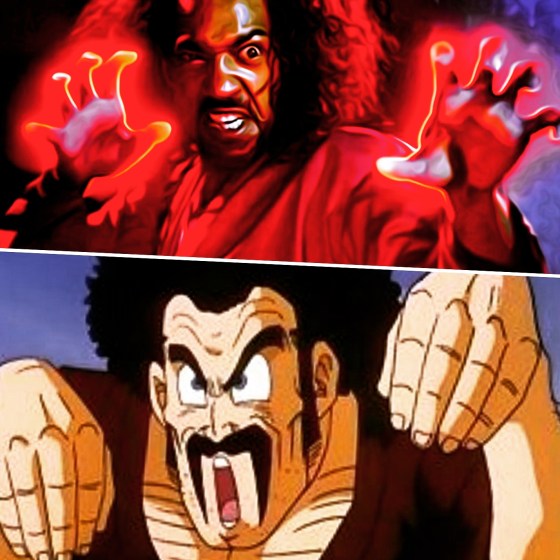
Well, let’s break some things down for a second – It may not be a landslide, but in a showdown between Sho’Nuff and Hercule, the outcome is likely dependent upon the rules of the match. Hercule is STRONG, but he hasn’t ever tapped into his ki; he relies purely on physical strength to win his matches. This might in part be so because once the Z-fighters removed themselves from the 天下一武道会(Tenkaichi Budoukai) tournaments, there were no other fighters on Earth who had pushed themselves to a similar level, and therefore Hercule never HAD to learn to tap into his ki as a power source. So perhaps through more fighting, intense rivalries, and mental training, he could eventually learn how to use ki to become stronger, but until he is forced to, and presented with the opportunity to consider that prospect seriously, he will never grow beyond his peak physical strength. In fact, it might be actually be the fault of the Z-fighters and Cell for changing so dramatically the scale of the tournament’s battles. Competing at their level of intensity would preclude lower-level fighters from meaningful participation – they simply wouldn’t be able to bridge the gap in ability – and thus lead to Hercule’s incredulity and halted development.
All of that said, IF Hercule learned to tap into his ki, he would be a much stronger fighter. His strength and standing as champion are at least partially valid. But Sho’Nuff HAS learned to tap into his ki – and he believes strongly enough in himself to continue pushing and enhance his use of that power. He has demonstrated considerable strength against ‘Bruce Leroy’ and all those he defeated in his campaign to become the undisputed Shogun of Harlem. In fact, he’s kind of like a low level Z-fighter – more than adequate in strength alone to hold his own against Hercule at his current level. But if Sho’Nuff were in the world of Dragonball, he would be sure to seek out Goku and the other fighters, forcing himself to grow. He would embrace the challenge instead of running away like a punk.
They’re both on a similar level in terms of physical strength alone, but Sho’Nuff has the ki advantage, the will to learn, and the courage to challenge himself. Hercule doesn’t. Hercule CAN’T win. So, who’s the master? Sho’Nuff.
-Namakemono
Category Archives: Japan
Random Thought Of The Day: Welcome Back, And HTML, Too
Affordable Care Act:
How to Make the Real Fix
I originally penned this short introspection at a rather contentious point in the government debate over the state of health care in America. While I never planned to share it publicly, I have since decided to do so only because it is fairly well written, and I wanted to practice with content that was more interesting to read than “lorem ipsum.” Whether you appreciate the substance or the framework behind it, enjoy.

The problem with the Affordable Care Act isn’t simply the provision (or lack) of insurance itself, but rather, lies in the practices and habits of Americans that force us to rely on health care in the first place.
A major aspect of the affordable care act should focus not just on providing health coverage for all, but also on providing guidance and reform on proper habits and lifestyles for all. While living in Japan for five years, I came to know very well a system which provided an affordable public option, based upon your income over the Japanese fiscal year, and recalculated on a year-to-year basis. While it was certainly reassuring to see that even in the poor rural area where I lived, regular folks (like the senior citizens operating their main-street retail shops more out of boredom nostalgia than for income, or the young day-laborers making under 1000 dollars a month) could afford to head to the doctor on a regular basis and have their issues looked at without losing an arm and a leg, what struck me more was the way in which societal norms promoted general health and fitness from a very young age.
Numerous studies have shown that promoting healthy attitudes and behaviors from a young age tends to lead to healthier and happier adults. If it promoted the adoption of healthy attitudes and practices as a matter of course and not a choice, the Affordable Care Act would stand as a stronger tool for reshaping health as opposed to simply health care in America.
-Namakemono
Six Minutes: The 2011 Tohoku Earthquake
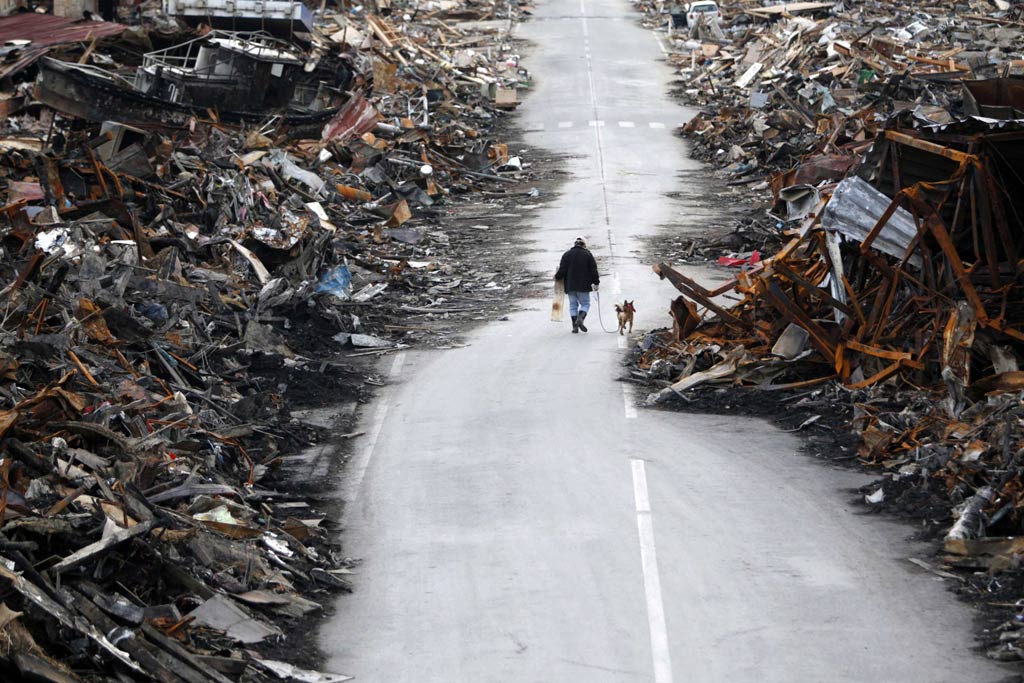
The Tohoku earthquake and tsunami, as well as the subsequent meltdown debacle are events that I am lucky enough to have experienced first-hand, yet walk away from. I am obviously grateful for this, yet at the same time filled with sadness over those less fortunate than I, who were literally in the wrong places at the wrong time. I will never forget my experience on that day in March 2011.
I still remember it like it was yesterday. I had just left school after a long day of that particular brand of play-teaching one employs on 小学校 days, but by all accounts it was still a (brisk) beautiful day. After a quick zip down my favorite mountain back roads in my Subie, I stopped in at my office to check in and round off the day before following through on plans to hop on my motorcycle for a quick spin. Right as I began a fluffy conversation with the only other two folks in my department, things began to shake. This wasn’t particularly nerve-wracking; I’d experienced quakes before but always held them in this contemptuous light, openly mocking them on a regular basis. As the conversation shakily continued, the large overhanging 教育委員会 sign swung furiously, with no sign of letting up.
Normally, within a minute of starting up, things tended to settle down and people brushed themselves off, picked up the few things that may have fallen, and resumed their daily routines. On March 11, however, it was clear that this earthquake was only getting started. The old town hall building was sturdy, but soon the slight jiggle underneath my feet and the furious shaking of the signs merged together, and the entire building began lurching precariously. Two and a half minutes in and everyone knew that this was NOT a “normal” earthquake. The old ladies of the tea ceremony club and various office staff began gathering in the lobby of the building, unsure of what to do or where to go, but finding comfort amongst numerous others who felt the same sense of unsurety. When I could feel the heaviness of the floors above in my feet, I knew it was time to go outside to an open area immediately, if for nothing more than my own peace of mind.
Outside I watched the parking lot turn into Jell-O, as it wobbled like it had been plucked, along with the cars, trees, and street lamps attached to it. This point was the first time I had ever given any real consideration to the fact that I could possibly die on this escapist island paradise of mine. Noticing that no one had followed me out of the jiggling building, I resigned to see the rest of the situation through with my co-workers inside. After what seemed like an eternity, during which I was all but convinced that the old building we occupied would collapse around us, the shaking and rumbling subsided. After six minutes of uncertainty, things went back to normal. Or so it seemed. We all expressed our relief at the experience drawing to a close, and I went home for the day.
For me, the 2011 Tohoku Earthquake was a somber lesson not to trivialize or treat danger as a novelty, as well as another reminder that life is precious. Although I was shaken up, after those six minutes had passed, I was able to go home. I honestly didn’t realize that so many folks weren’t going to make it home, go to bed, and sleep off a bad day. Six minutes changed everything for them. The next morning, I woke up to the news of the tsunami and its devastation, and the developing crisis at 福島第一 , and only then did it strike me that the prior day’s rumbling was simply the tip of an iceberg that would change things for years to come.
Six minutes on March 11, 2011. How did you spend them?
-Namakemono
 Namakemono no Manifesto